U.S. publishes, moves forward with Iran deal as Trump clashes with Netanyahu
The White House on June 17 disclosed the text of a preliminary agreement with Iran that would ease sanctions on Tehran and reopen the Strait of Hormuz, as President Donald Trump continued to criticize Israel’s conduct in Lebanon and Vice President JD Vance dismissed hawkish Republicans’ complaints about the deal.

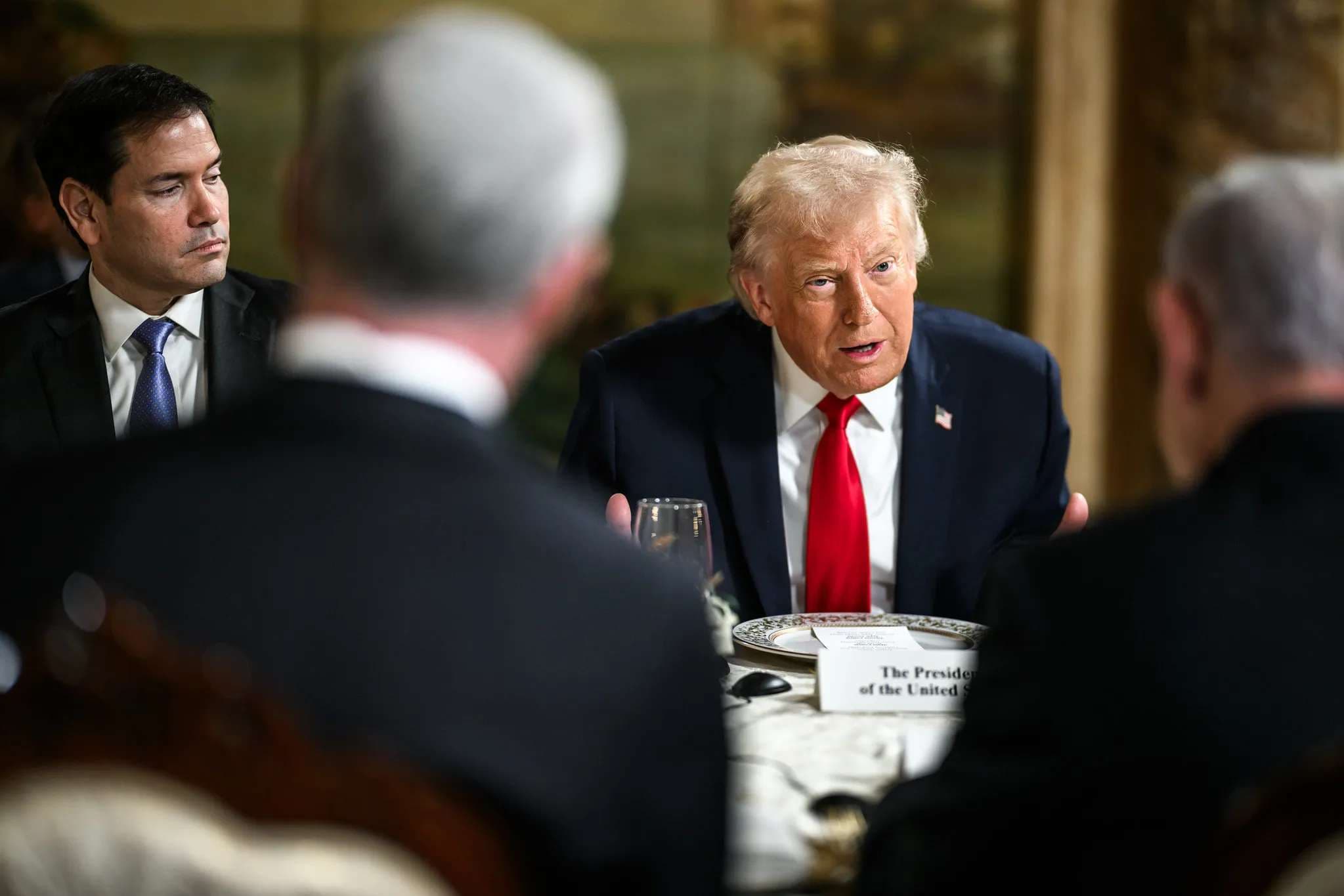
The White House on June 17 disclosed the text of a preliminary agreement with Iran that would ease sanctions on Tehran and reopen the Strait of Hormuz, as President Donald Trump continued to criticize Israel’s conduct in Lebanon and Vice President JD Vance dismissed hawkish Republicans’ complaints about the deal.
Trump again criticizes Netanyahu for Israel's Lebanon campaign
ABC News reported, citing an Israeli source and a U.S. official familiar with the matter, that the White House initially denied Israel's request to review the U.S.-Iran memorandum of understanding (MOU) before its planned ceremonial signing in Geneva on June 19. Although Israeli officials were "thoroughly briefed on the MOU's contents," they were not permitted to review the document itself. Israel is not a party to the memorandum.
The next day, Trump addressed Israel's role in the agreement during an appearance at the Group of Seven summit, renewing his recent criticisms of Netanyahu's handling of Hezbollah and Lebanon.
"We did send a copy to Israel, by the way," Trump said. "They've been a good partner. Again, I think they could do better with respect to Hezbollah. On that, I don't think they are doing well."
Trump took particular issue with high numbers of civilian deaths in Israel’s strikes on Lebanese locations. He described Netanyahu as "a good man" who "gets a little excited sometimes," and said the two leaders had "a little dispute over Lebanon."
"I say, ‘You can do a little softer touch, Bibi,’" Trump said. "You don't have to knock down a building every time somebody walks into it that's from Hezbollah."
During a June 16 bilateral meeting with the Emir of Qatar in France, Trump also said that out of “all countries,” Lebanon has “been treated the worst.”
"You don't want to knock down an apartment house every time you're looking for somebody, because there are a lot of people in those apartment houses," Trump said, "and they're not all Hezbollah, that I can tell you."
Trump suggested Syria could deal with Hezbollah more effectively than Israel and argued that Israel's military campaign in Lebanon was dragging on unnecessarily.
"I'm not happy with the way Israel has handled themselves with Lebanon and with Hezbollah," Trump said. "They should be able to do the job faster."
He framed Netanyahu's restraint on Lebanon as a prerequisite for preserving the broader Iran deal.
"Bibi has to be more responsible with respect to Lebanon," Trump said, adding that continued fighting there "throws a negative light on the big deal. And that's the deal with Iran."
The remarks echoed criticism Trump voiced after Israeli strikes in Beirut that he said jeopardized negotiations with Iran. As Zeale News previously reported, Trump said he was "very angry" after Israel launched strikes in Beirut following the White House's June 13 announcement that U.S. and Iranian officials were expected to sign an agreement the next day.
"Why did Bibi have to do a f***ing attack?" Trump said in a conversation with Axios. "I was so pissed off. I let him know. He has no f***ing judgment. I let him know that."
Trump also reiterated what he described as the unequal nature of the U.S.-Israel relationship, echoing remarks he made earlier this month that he, not Netanyahu, "calls the shots."
"He will say, 'We're the big partner and he's the very small partner,'" Trump said of Netanyahu. "And that's true."
The President further underscored what he described as Israel's reliance on U.S. support, arguing that no previous president had done as much for the country as he had.
"Without us, without the United States, there would be no Israel," Trump said. "Without me, there would be no Israel, because no other president was willing to do what I did."
Vance pushes back on Republican skeptics
Numerous hawkish commentators and political figures have criticized the MOU for its exclusion of Israel and for allegedly being too generous toward Iran. Former Secretary of State Mike Pompeo declared the framework "not remotely America First." Senate Republicans returning to Washington on June 16 demanded briefings before any agreement was finalized.
In an interview with ABC, Vance said he would "caution” naysayers against the MOU “not to believe the hardliner propaganda in Iran, but to believe what's actually in the agreement."
The White House's communications director, Steven Cheung, was more direct in response to Pompeo, telling him to "shut his stupid mouth."
Vance said the deal was fundamentally different from President Barack Obama's 2015 nuclear accord. According to the Vice President, Gulf states "love" Trump's deal and "hate" Obama's, and Iran "doesn't get a dime unless they behave and change their behavior," the Wall Street Journal reported. He said Iran faced a "two-path" choice: rebuild its nuclear program and face isolation, or commit long-term and gain economic integration.
What's in the deal
The 14-paragraph document — formally titled the Islamabad Memorandum of Understanding (MOU) (Pakistan mediated the talks) — commits the U.S. and Iran to an immediate and permanent cessation of hostilities on all fronts, including Lebanon, and establishes a 60-day window to negotiate a final agreement, extendable by mutual consent. A senior U.S. official disclosed the full text during a June 17 conference call with The New York Times, speaking on condition of anonymity under White House ground rules.
The agreement requires Iran to restore commercial traffic through the Strait of Hormuz, with shipping expected to resume immediately and return to prewar levels within 30 days. In exchange, the U.S. agreed to begin lifting its naval blockade immediately upon signing and remove it entirely within 30 days. Treasury Department waivers allowing Iranian crude oil exports — along with related banking, insurance, and transportation services — would take effect simultaneously.
One provision highlighted by The Times states that commercial vessels may pass through the Strait "with no charge for 60 days only," raising the possibility that Iran could seek to impose fees after that period expires. The newspaper noted such a move could conflict with a negotiating objective previously outlined by Secretary of State Marco Rubio, who said maritime commerce should return to prewar conditions.
The memorandum also commits the U.S. to work with regional partners on a reconstruction and economic development plan for Iran worth at least $300 billion. It further provides for the release of Iranian funds frozen abroad — estimated at $24 billion or more — upon implementation of the MOU. The agreement states those funds may be directed to "any ultimate beneficiary designated by the Central Bank of the Islamic Republic of Iran."
On sanctions, the U.S. agreed in principle to terminate all measures against Iran, including United Nations Security Council resolutions, International Atomic Energy Agency (IAEA) board resolutions, and U.S. primary and secondary sanctions, according to a timetable to be negotiated in the final agreement.
The nuclear provisions are contained in a single paragraph. Iran reaffirmed that it will not procure or develop nuclear weapons and agreed that its stockpile of highly enriched uranium would be diluted through a process known as down-blending under IAEA supervision.
The memorandum does not require Iran to remove the material from the country. The Times noted that the 2015 nuclear agreement negotiated under Obama required Iran to ship all but 3% of its stockpile to Russia. The new document also leaves unresolved whether Iran will ultimately be permitted to continue enriching uranium for civilian purposes.
Pending a final agreement, both sides agreed to maintain the status quo. Iran would freeze its nuclear program in its current state, while the U.S. would refrain from imposing new sanctions or deploying additional forces to the region. The memorandum also calls for the creation of a monitoring mechanism to verify compliance and states that any final agreement would be endorsed by a binding U.N. Security Council resolution.
Trump defended the framework during remarks at the Group of Seven summit, while acknowledging that negotiations remain incomplete.
"It's a memorandum of understanding," Trump said. "And if I don't like it, we'll go back to shooting at them, dropping bombs on their head."
Asked how the agreement would be enforced absent binding language, Trump replied: "If you don't adhere to the agreement ... we're going to bomb the hell out of you."
Trump also signaled flexibility on two issues that many Iran hawks have identified as red lines. He suggested Iran could retain some ballistic missile capabilities, noting that neighboring countries also possess missiles, and left open the possibility that Tehran could continue enriching uranium for civilian energy purposes.
"It's a little hard when other people have it, other adjoining states have it, and you're not letting them have it for purposes of electricity and things like that," Trump said. "You have to use a little common sense."
When asked about concerns that Iran could impose future fees on commercial traffic through the Strait of Hormuz, Trump said, "The thing that's going to stop them from doing that is common sense. They don't want to get bombed."